The Use of Adaptive Bias
in Power Amplifiers
These goals had consequences in virtually every aspect of the design of the Nº 33, ranging from the power supplies to the fully balanced nature of the amplifier topology. Within the narrow scope of this technical paper, however, we will limit the discussion to the effects of these two goals on our decision to develop our own Adaptive Bias scheme for the output stage of the amplifier. (All Mark Levinson 300 Series Dual Monaural Power Amplifiers use the same technology.)
As applied to the output stage, the goal of unsurpassed sonic excellence indicates (among other things) a high level of output bias to minimize crossover distortion introduced when those devices shut off. Specifically, we wanted to exceed the Class A operational area of the Nº20.6, which operates in Class A at 100 watts into an 8 ohm load. We also wanted to avoid any possibility of reverse-biasing an output device. (Reverse-biased transistors are shut off hard, introducing high frequency spikes of crossover distortion.)
The second goal of extremely high power into low impedances requires
a large number of output devices to source the required current. The combination
of
high output bias and a large number of output devices normally results
in a huge quiescent current and consequent thermal management problems
when the amplifier is at idle.
The Limitations of Traditional Bias Technology
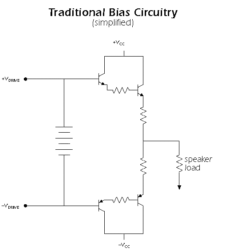
In a traditionally biased amplifier, a fixed voltage is placed across the output devices, one that is not referenced to the load itself in any way. As the current demanded by the load increases, the voltage across one emitter resistor (on the current sourcing side of the amplifier) increases, while the voltage across the other emitter resistor decreases. When the voltage across the first exceeds the bias level, the second emitter resistor voltage drops to zero, and the output device that would normally be considered the current "sink" is reverse biased. It is this hard turn-off of the output device that Class A operation seeks to minimize by virtue of extremely high bias levels.
Unfortunately, real-world loudspeaker loads exhibit complex impedances that frequently drop below 8 ohms. As the impedance of the load drops, the current it requires increases. This, in turn, increases the voltage across the sourcing emitter resistor more rapidly than would have been the case with an 8 ohm load. As a result, with complex and/or low impedances, even conservatively designed amplifiers that might be characterized as "Class A" will be forced to operate outside Class A parameters.
In theory, the problem of shutting off output devices at low impedances and high currents could be addressed by raising the bias level even further-in effect, to bias for Class A operation at, say, 2 ohms instead of 8 ohms. While this solution would prevent the unwanted transistor turn-off at lower impedances, it would vastly increase the quiescent current. The resultant thermal problems are so severe that we know of no amplifier since the original Mark Levinson ML-2 that has been so biased.
Yet our goals remained: unsurpassed sonic excellence (requiring high bias) and unmatched power (requiring many output devices), the combination resulting in excessive heat. Hence the classic dilemma: how does one design an amplifier with the finesse of a simple, small, single-ended design, but with huge reserves of power needed to fully and accurately reproduce the dynamic range of modern source material?
Variable Bias Explained
Given the need to have both a reasonably low quiescent current at idle and a high level of bias at high signal levels, the simplest solution is to modulate the bias level as a function of the input signal. By causing the bias level to track the input voltage proportionally, it would seem that you could have the best of both worlds: relatively low bias under low signal conditions and progressively higher bias as the signal demands.Unfortunately, variable bias amplifiers have rarely lived up to expectations. In our investigations, it became clear that many of their limitations could be traced to power supply inadequacies. In effect, the varying current requirements of the output stage bias circuitry introduced variations in the power supply. This instability, in turn, wreaked havoc in the sensitive voltage gain stages of the amplifier. With better power supply isolation between different portions of the amplifier, many of these shortcomings can be avoided.
Yet power supply refinements alone could not address a fatal weakness in the implementation of variable bias: merely causing the bias level to track proportionally with the input signal doesn't work.
The simplistic approach of tracking the input signal ignores a crucial element in the circuit-namely, the loudspeaker. In addition to its role as transducer, the loudspeaker load dictates the current required from the amplifier for any given output voltage. With low or complex impedances, even a proportional sliding bias scheme such as described above can easily be forced to shut down the current sink transistors, since the higher current required creates a higher-than-proportional voltage across the sourcing emitter resistor. The resulting reversion to Class B operation reintroduces the crossover distortion that the complex sliding bias circuitry originally sought to avoid.
The Answer: Adaptive Bias
In designing the next generation of Mark Levinson amplifiers, we felt it essential to take into account both the input signal and the load being driven, since both affect the operational condition of the output devices. The result is a circuit that implements the optimal bias at all times between predetermined minimum and maximum levels by including the output current demanded by the loudspeaker in the bias control system.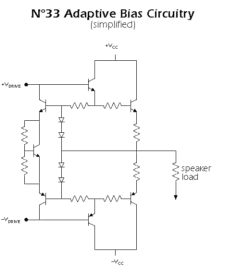
The key to understanding this approach lies in the use of a reference
level for output bias conditions in conjunction with a circuit using a
combination of both linear and non-linear elements. This circuit continuously
compares the reference level to output conditions. By exploiting the non-linear
properties of diodes, a scaled portion of quiescent bias can be removed
from the output device which in traditional approaches would be shut off.
Even under the most adverse combination of signal and load conditions, the unused output device is closed down gradually. This stands in stark contrast to a purely linear system, in which the side of the amplifier not responsible for sourcing current simply crashes down to zero current flow and is frequently reverse-biased by a combination of high signal level and low load impedance.
Of course, the proof of the value of this approach is in the performance of the amplifier itself. While it would be inappropriate to attribute the overall performance of the amplifier to any single circuit detail, the high frequency crossover distortions characteristic of even the finest transistor amplifiers (including so-called "Class A" designs) are minimized to a remarkable degree in the new Mark Levinson amplifiers.
P.O. Box 781
Middletown, CT 06457
Fax: 860-346-1540
Copyright 1998 Madrigal Audio Laboratories